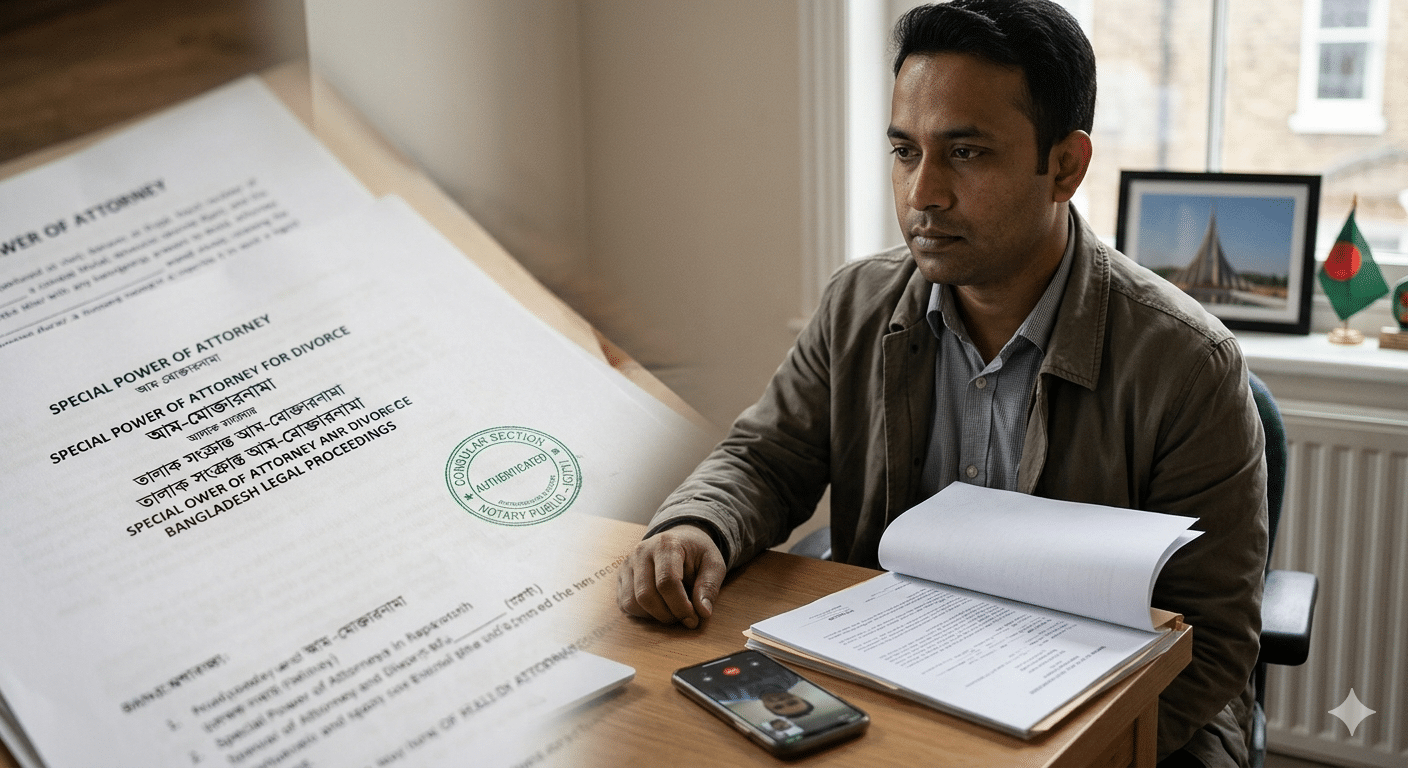
In today’s globalized world, cross-border marriages are increasingly common. Consequently, legal issues such as cross-border divorce involving spouses residing in different jurisdictions are also on the rise. For Bangladeshi nationals, a frequent scenario arises where the husband resides abroad and wishes to initiate divorce proceedings in Bangladesh.
This article provides a step-by-step legal guide on how a husband living overseas can validly execute a divorce under Bangladeshi law, ensuring compliance and enforceability.
Legal Framework Governing Divorce in Bangladesh
For Muslims in Bangladesh, divorce is primarily governed by the Muslim Family Laws Ordinance, 1961, particularly Section 7, which regulates the procedure of Talaq (divorce by husband).
Failure to comply with statutory requirements may render the divorce ineffective or legally challenged.
Can a Husband Living Abroad Give Divorce in Bangladesh?
Yes. A husband residing abroad can legally pronounce divorce, provided that:
- The divorce is executed in accordance with Bangladeshi law
- Proper notice is served through the appropriate authority
- Documentation and procedural compliance are maintained
The process is often completed through a Power of Attorney (POA) granted to a representative in Bangladesh.
Step-by-Step Procedure for Cross-Border Divorce
Step 1: Drafting the Divorce Notice (Talaq Notice)
The husband must prepare a written notice of Talaq, clearly stating:
- Intention to divorce
- Details of marriage (date, dower, etc.)
- Wife’s full identification and address
This notice is the foundation of the legal process.
Step 2: Execution of Power of Attorney (If Abroad)
If the husband is outside Bangladesh, he should execute a Power of Attorney authorizing a trusted individual to act on his behalf.
Key requirements:
- Must be executed before a Notary Public / Bangladesh Embassy / Consulate in the foreign country
- Should specifically authorize issuance and filing of divorce notice
Step 3: Attestation
The Power of Attorney must be:
- Attested by the Bangladesh Embassy/Consulate
- Sent to Bangladesh via courier
Upon receipt, it may require adjudication (stamp duty compliance) under local laws.
Step 4: Submission of Divorce Notice to Local Authority
The authorized representative submits the divorce notice to the:
➡️ Chairman/Mayor of the local Union Parishad / Pourashava / City Corporation where the wife resides
This is a mandatory legal requirement under Section 7 of the Ordinance.
Step 5: Service of Notice to Wife
The authority will:
- Send a copy of the notice to the wife
- Initiate reconciliation proceedings through an Arbitration Council
Step 6: Mandatory Waiting Period (90 Days)
The divorce does not take effect immediately.
- A 90-day period must lapse from the date of notice
- During this period, reconciliation efforts are made
If reconciliation fails, the divorce becomes effective after expiry of the waiting period.
Step 7: Issuance of Divorce Certificate
After completion of the process:
- The local authority issues a Divorce Certificate
- This serves as legal proof of dissolution of marriage.
Important Legal Considerations
1. Validity of Foreign Divorce
A divorce pronounced abroad without following the procedure under Bangladeshi law may not be recognized in Bangladesh.
2. Maintenance and Dower (Denmohor)
The husband remains liable for:
- Payment of unpaid dower
- Maintenance during iddat period
3. Risk of Criminal Liability
Failure to notify the authority under Section 7 may expose the husband to legal penalties.
Why Legal Assistance is Essential
Cross-border divorce involves multi-jurisdictional compliance, document authentication, and procedural accuracy. Any defect can lead to:
- Invalid divorce
- Future litigation
- Financial liabilities
Engaging an experienced law firm ensures proper documentation, timely filing, and legal protection.
Conclusion
A husband living abroad can legally divorce his wife in Bangladesh, but only by strictly following the procedure laid down in the Muslim Family Laws Ordinance, 1961. The involvement of local authorities and adherence to statutory timelines are critical to ensure the divorce is valid and enforceable.